
問題1
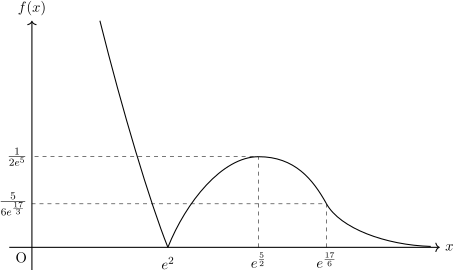
$g(x)=\dfrac{\log x-2}{x^2}$とする。
\begin{aligned} g'(x) &=\frac{\dfrac{1}{x} \cdot x^2-(\log x-2) \cdot 2x}{x^4} \\ &= \frac{1-2(\log x-2)}{x^3} \\ &= \frac{5-2\log x}{x^3} \end{aligned}
\begin{aligned} g^{\prime\prime}(x) &= \frac{-\dfrac{2}{x} \cdot x^3-(5-2\log x) \cdot 3x^2}{x^6} \\ &= \frac{-2-3(5-2\log x)}{x^4} \\ &= \frac{6\log x-17}{x^4} \end{aligned}
よって、$g(x)$の増減と凹凸は次のようになる。
| $x$ | $0$ | $\cdots$ | $e^{\frac{5}{2}}$ | $\cdots$ | $e^{\frac{17}{6}}$ | $\cdots$ |
| $g^{\prime\prime}(x)$ | × | $-$ | $-$ | $-$ | $0$ | $+$ |
| $g^{\prime}(x)$ | × | $+$ | $0$ | $-$ | $-$ | $-$ |
| $g(x)$ | × | $\nearrow$(上凸) | $\dfrac{1}{2e^5}$ | $\searrow$(上凸) | $\dfrac{5}{6e^{\frac{17}3}}$ | $\searrow$(下凸) |
また、$\displaystyle\lim_{x\to +0}g(x)=-\infty$、$\displaystyle\lim_{x\to \infty}g(x)=0$である。
\begin{eqnarray} f(x)= \begin{cases} -g(x) & (0 \lt x \leqq e^2 ) \\ g(x) & (e^2\leqq x) \end{cases} \end{eqnarray}から、$f(x)$のグラフは下図のようになる。
(2)
方程式$f(x)=a$の解の個数は、$y=f(x)$のグラフと直線$y=a$の共有点の個数に等しい。(1)のグラフから、求める個数は次のようになる。
- $a=0$、$a\gt\dfrac{1}{2e^5}$ のとき$1$個
- $a=\dfrac{1}{2e^5}$ のとき$2$個
- $0\lt a\lt\dfrac{1}{2e^5}$ のとき$3$個
問題2
任意の負でない整数$n$に対し$\displaystyle\lim_{x\to \infty} \dfrac{x^n}{e^x}=0$である。よって、ある正数$t(n)$が存在し、$x\gt t(n)$ならば次の式が成り立つ。 \[0\lt \dfrac{x^{n+2}}{e^x}\lt 1\] よって、次の式が成り立つ。 \[0\lt \dfrac{x^{n}}{e^x}\lt \dfrac{1}{x^2}\]
$t(n)\lt a$のとき \begin{aligned} \int_0^a \frac{x^n}{e^x} \,dx &= \int_0^{t(n)} \frac{x^n}{e^x} \,dx + \int_{t(n)}^a \frac{x^n}{e^x} \,dx \\ &< \int_0^{t(n)} \frac{x^n}{e^x} \,dx + \int_{t(n)}^a \frac{1}{x^2} \,dx \\ &= \int_0^{t(n)} \frac{x^n}{e^x} \,dx + \left[ -\frac{1}{x} \right]_{t(n)}^a \\ &= \int_0^{t(n)} \frac{x^n}{e^x} \,dx + \frac{1}{t(n)} - \frac{1}{a}\\ &< \int_0^{t(n)} \frac{x^n}{e^x} \,dx + \frac{1}{t(n)} \end{aligned}
$a\gt 0$で定義された関数$\displaystyle\int_0^a \dfrac{x^n}{e^x} \,dx$は単調増加であり、上に有界である。よって、$a\to \infty$のとき収束する。その極限を$I_n$とする。
\begin{aligned} \int_0^a e^{-x} \,dx &= \left[-e^{-x} \right]_0^a \\ &=1-\frac{1}{e^a} \end{aligned}から、$I_0=1$である。
また、 \begin{aligned} \int_0^a x^{n+1} e^{-x} \,dx&= \left[-x^{n+1} e^{-x} \right]_0^a+\int_0^a (n+1) x^ne^{-x}\,dx \\ &= -\frac{a^{n+1}}{e^a} + (n+1) \int_0^a \frac{x^n}{e^x} \,dx \end{aligned}から、$I_{n+1}=(n+1)I_n$である。
よって、$I_n=n!$である。
補足
$\displaystyle\lim_{x\to \infty} \dfrac{x^n}{e^x}=0$から直接に$\displaystyle\int_0^{\infty} \dfrac{x^n}{e^x} \,dx$が収束するとは言えません。
例えば、次の2式は同時に成り立ちます。 \begin{aligned} &\lim_{x\to \infty} \dfrac{1}{x}=0 \\ &\int_1^{\infty} \dfrac{1}{x} \,dx=\infty \end{aligned}
問題3
(1)
$|x|\leqq 1$のとき、立体$C\cap D$は点$(x,0,0)$を含む。逆に、$|x|\gt1$のとき、$D$の$y$は存在しない。 $S$の定義域を$[-1,1]$とする。
各$x$に対し、$C$の切り口は、$(x,\pm(\sqrt2-|x|),0)$と$(x,0,\pm(\sqrt2-|x|))$を頂点とする正方形である。
$C\cap D$の切り口は、この正方形から、$|y|\gt \sqrt{1-x^2}$となる部分(2つの直角二等辺三角形)を除いたものである。
\begin{aligned} S(x)&=\frac{1}{2}\{2(\sqrt{2}-|x|)\}^2-\frac{1}{2}\{2(\sqrt{2}-|x|-\sqrt{1-x^2})\}^2 \\ &=2(\sqrt{2}-|x|)^2-2\left\{(\sqrt{2}-|x|)-\sqrt{1-x^2}\right\}^2 \\ &=2(\sqrt{2}-|x|)^2-2\left\{(\sqrt{2}-|x|)^2-2(\sqrt{2}-|x|)\sqrt{1-x^2}+(\sqrt{1-x^2})^2\right\} \\ &=4(\sqrt{2}-|x|)\sqrt{1-x^2}-2(1-x^2) \\ &=4\sqrt{2}\sqrt{1-x^2}-4|x|\sqrt{1-x^2}-2(1-x^2) \end{aligned}
(2)
求める体積は \begin{aligned} &\int_{-1}^1 \left\{4\sqrt{2}\sqrt{1-x^2}-4|x|\sqrt{1-x^2}-2(1-x^2)\right\} dx \\ =&4\sqrt{2}\cdot\frac{\pi}{2}-8\int_0^1 x\sqrt{1-x^2} dx-4\int_0^1 (1-x^2) dx \\ =&2\sqrt{2}\pi-8\left[-\frac{1}{3}(1-x^2)^{\frac{3}{2}}\right]_0^1-4\left[x-\frac{x^3}{3}\right]_0^1 \\ =&2\sqrt{2}\pi-\frac{8}{3}-4\cdot\frac{2}{3} \\ =&2\sqrt{2}\pi-\frac{16}{3} \end{aligned}